

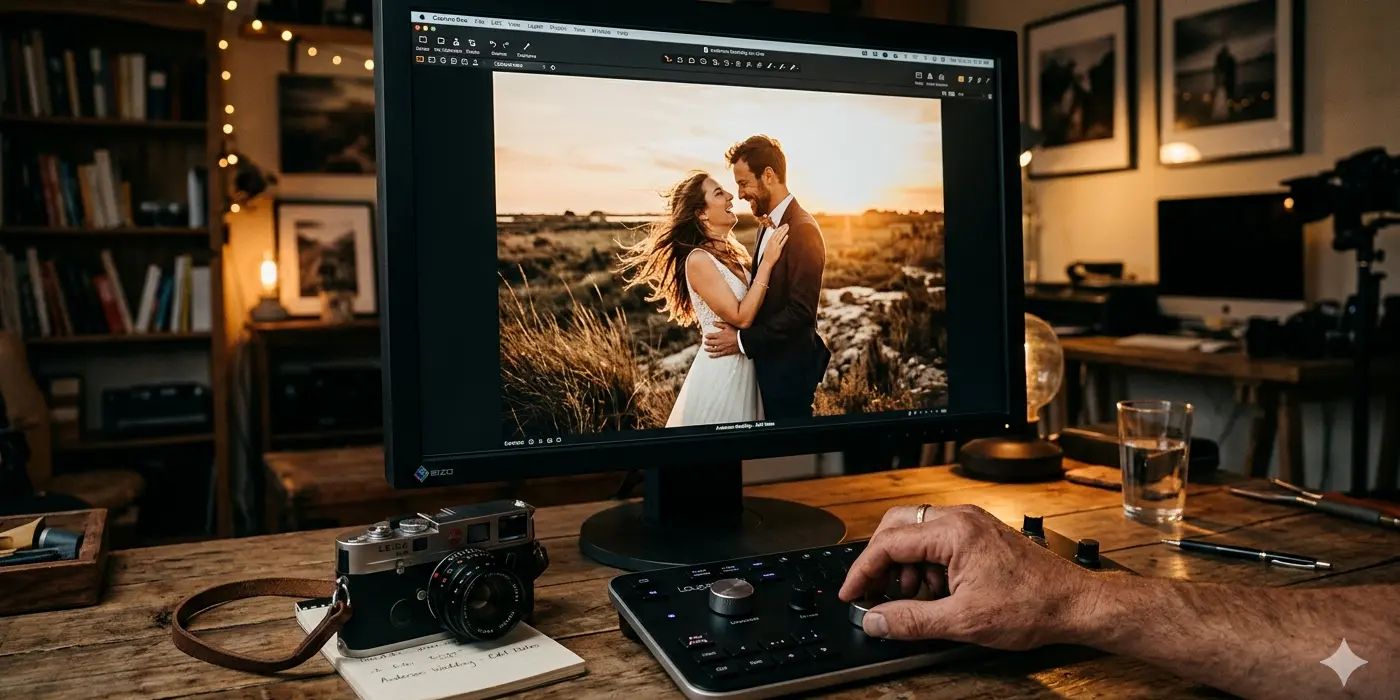
There’s a question couples ask me more and more often—sometimes directly, sometimes indirectly. It goes something like: “Do you use artificial intelligence to edit your photos?” Beneath that question, there’s a real concern. The fear of receiving images that don’t feel like anything—too smooth, too perfect, homogenized by an algorithm that doesn’t know them, that wasn’t there, that experienced nothing of that day.
I understand that concern. And I want to answer it honestly—without dodging, without posturing. Neither pro-AI at all costs nor opposed on principle. Just the truth about how I work—and what I believe wedding photography deserves to be.
What editing really is: a conversation with the image
When I return from a wedding in the Camargue, Petite Camargue, on a vineyard estate between Nîmes and Montpellier, or along a wild beach near Arles, I bring back thousands of raw images. RAW files. Files that don’t look like much yet—intentionally underexposed, slightly cool, without final color. That’s deliberate. I leave room for editing. I shoot with what I will do afterward in mind.
For me, editing is the second part of the photographic process. Not a cosmetic addition. Not a correction. It’s where I finalize the atmosphere, where I choose the grain, the warmth of tones, how the shadows will behave. It’s where the image stops being a capture and becomes a photograph—in the full sense of the word. This stage is intimate, time‑consuming, and entirely manual. It’s a conversation between me and each image, and I don’t want an algorithm stepping in uninvited.
My style doesn’t export into a preset and can’t be delegated to a machine
What I call my style is something built over years of photographing weddings in the South of France—in that particular Camargue light, under a sky that burns in summer and softens in autumn. This style is made of repeated choices: the way I handle whites without blowing them out, how I keep detail in the shadows without flattening them, allowing a subtle grain that recalls film texture, giving warm tones that amber softness that defines the visual identity of my work.
These choices aren’t stored in a file. They’re in my memory, in my eye, in habits built image after image. No AI tool can reproduce them because no AI tool has built them. They are the product of human experience—subjective, rooted in a specific place. That’s precisely what makes photos I shoot look like mine—and not like anyone else’s.
What this means for you in practice
Every delivered photo has been individually reviewed and edited. Not batch‑applied with an automatic preset. Not processed in bulk with generative AI. Your wedding has its own light, its own colors, its own timing. The editing respects that uniqueness.
What I’m willing to entrust to AI—and why it’s different
Let’s be clear: I do use AI. But in a targeted way, for tasks that have nothing to do with artistic creation. These are technical, repetitive tasks, with no aesthetic stakes—problems to solve, not choices to make.
Sensor spot and dust removal
Every camera accumulates dust over time. During an outdoor wedding shoot—a dusty bull ranch in the Camargue, a windy beach near Saintes‑Maries‑de‑la‑Mer, a vineyard estate during harvest—sensor spots are inevitable. Detecting and removing them one by one across a thousand images is an absurd task that AI handles perfectly, invisibly, with no impact on how the image is perceived. That’s maintenance, not creation. I gladly delegate it.
Noise reduction in low light
A wedding doesn’t stop when the light becomes ideal. The first dance, speeches, embraces under dim lighting late in the evening—these are essential moments I can’t miss just because lighting conditions are difficult. I raise the ISO. I recover the image. And to remove digital noise without destroying detail or creating the blur typical of aggressive noise reduction, modern AI algorithms—Lightroom Denoise, Topaz DeNoise—do a remarkable job that traditional methods simply can’t match. The result is a clean image that preserves intended grain and texture. Not a plastic‑smooth image.
Perspective correction and assisted cropping
On certain architectures—a Romanesque chapel in the Gard, a farmhouse with thick walls and asymmetrical openings—lines converge. Perspective correction is a purely geometric operation. AI handles it quickly and accurately. I confirm or adjust. That’s it.
The rule I set for myself
If AI solves a technical problem without affecting the atmosphere, color, grain, or storytelling of the image—I use it. If AI starts suggesting a style, changing tones, or “enhancing” an image based on its own criteria—I don’t want it. That’s the line, and it’s clear.
Why this distinction really matters for your wedding photos
You could say this is a photographer’s concern and that couples don’t need to worry about it. I disagree. Because this distinction directly impacts what you receive.
A photographer who processes their images using AI style generators delivers photos that look like thousands of others treated with the same tool. The style isn’t theirs—it’s that of an algorithm trained on generic image datasets. This isn’t about technical quality. It’s about identity and uniqueness. Your wedding photos deserve something recognizable that belongs to your photographer—not to a data library.
A wedding report shot in Arles in October, with that autumn light on the stones, with the mistral moving the grasses of the Camargue—this report has a unique atmosphere. My editing aims to reveal it, not replace it with something cleaner, more standardized, more “beautiful” according to statistical criteria. The best wedding photos I’ve made aren’t the most technically perfect. They’re the ones that tell something real with the light that existed that day.
AI doesn’t know what happened that day
This may be the simplest thing to say—and the most fundamental. AI wasn’t there. It doesn’t know that the low evening light at 7 p.m. on the farmhouse was exactly what highlighted the color of your eyes. It doesn’t know that moment of restraint just before entering the room deserved a cooler, quieter palette—because that’s what it was. It doesn’t know that the warmth of the reception space, filled with candles and soft lighting, called for deep amber tones rather than a cold, neutral correction.
I know. Because I was there. Because I lived that day with you—from a few steps away, at the back of the room, behind the reeds, at the top of the stairs. Handcrafted post‑processing is the memory of what I saw and felt that day, translated into technical choices. It’s a continuation of reportage work—not a separate operation handed off to software.
What you can expect from my editing work
An honest delivery time—because every image is reviewed, not batch‑processed. Visual consistency across the entire report—because style is applied image by image, taking into account the lighting conditions of each moment. And photos that look like you—not like an Instagram trend of the year.
Photographic craftsmanship and technology: how they coexist
I want to be precise on one point: this text is not a statement against technology. I use a digital camera, lenses designed by engineers, editing software developed by a company whose algorithms are partly powered by machine learning. Technology has been part of my tools from the beginning. The question isn’t about being free of it—it’s about remaining in control of it.
Craftsmanship isn’t rejecting modern tools. It’s having a conscious and deliberate relationship with them—knowing what you entrust to them and why, knowing what you keep for yourself and why. A cabinetmaker who uses an electric sander to prepare a surface and then carves by hand hasn’t betrayed their craft. They’ve simply understood where their artistic responsibility begins and ends.
That’s exactly my position. AI prepares the surface. I sculpt.
What this changes for you, concretely
If you’re looking for a wedding photographer in the Camargue, the Gard, Arles, Nîmes, or Montpellier, this post‑processing philosophy has practical consequences you can verify even before contacting me.
Look at the consistency of my work — not just a single sunset shot that turned out well, but an entire report, from morning to night, under all lighting conditions. If the style holds throughout the day, if shadows and highlights are treated consistently, if low‑light evening images share the same visual identity as those taken in bright afternoon sun—that’s the sign of true craftsmanship, not a preset mass‑applied to the most favorable images.
That consistency is what makes a wedding report feel like a story. That the first and last image belong to the same world. That in twenty years, when you look back at them, you don’t see an album of 2026 photography trends—but your day, as it truly was.
Are you looking for a photographer who treats your story with the same care as they capture your emotions? Let’s talk.