

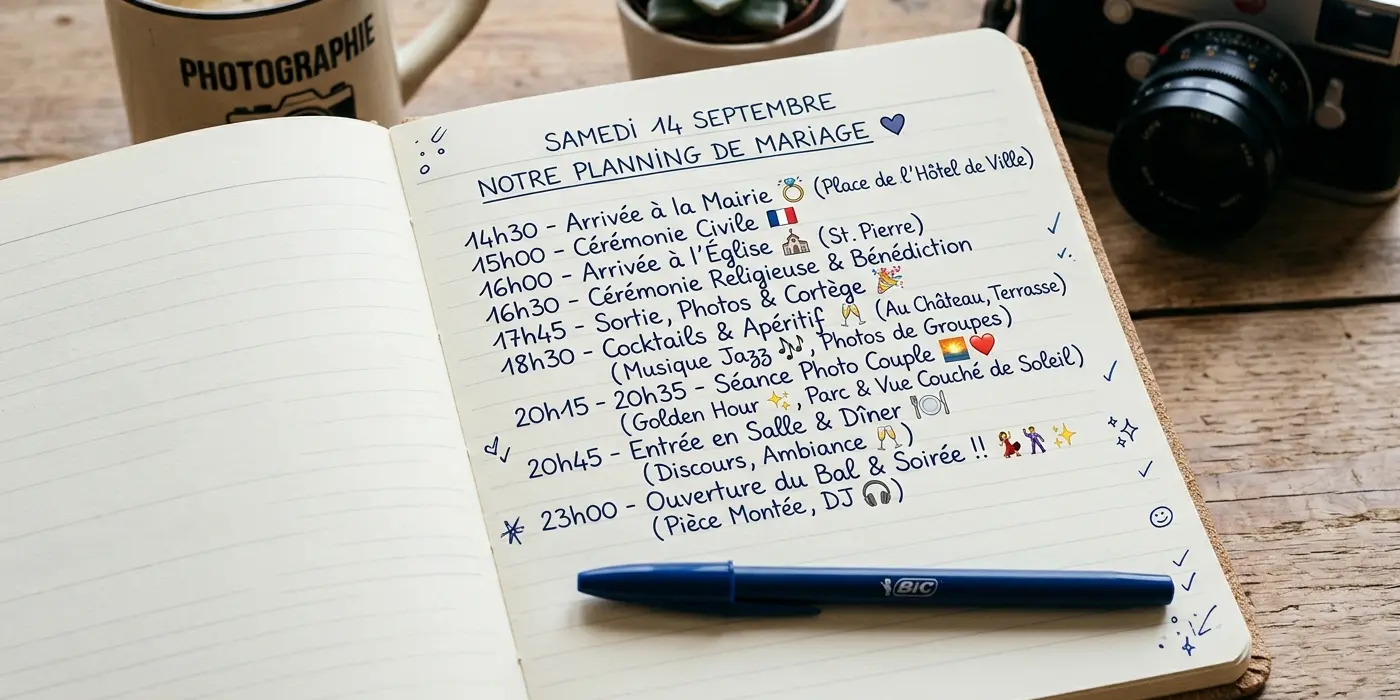
There are days that unfold like a breath. Where no one is rushing, no one is stressed, where moments flow with an almost unreal sense of ease. And yet, behind this apparent lightness, there is work, trust, and genuine collaboration between the people running things behind the scenes. The relationship between a wedding photographer and a wedding planner is exactly that: a discreet, prepared, aligned duo — whose importance you only truly realize at the end of the day, when you notice that nothing went wrong.
I work in the Nîmes, Arles, and Montpellier region, often in the heart of the Camargue, among Provençal farmhouses, vineyards, and wild seaside landscapes. These locations are beautiful, but they are also unpredictable. The light changes quickly. Distances between areas can be significant. And a wedding day cannot be replayed. That’s precisely why coordination — and communication between vendors — is at the core of how I work.
Photographer and wedding planner: two professions, one shared vision
For a long time, these two roles were seen separately. The photographer arrives, captures, and leaves. The coordinator manages logistics, directs vendors, and ensures everything runs smoothly. In reality, when the collaboration works well, both roles feed into each other — and it’s the couple who benefits the most directly.
A wedding planner or day-of coordinator has a global view of the day. They know when the caterer sets up the tables, when the musicians arrive, how long it actually takes to move between the ceremony and the venue. This knowledge of the field allows me, as a photographer, to anticipate: where I need to be, at what time, and in what light. Without this information, I’m navigating blindly. With it, I can build a coherent, fluid approach — and above all, stay available for what matters most: genuine emotions, shared looks, unscripted laughter.
Practical complementarity in the field
The coordinator is often the first point of contact for vendors on-site. They defuse small logistical tensions before they ever reach you. Meanwhile, I can remain fully focused on you — on your father holding back tears during the ceremony, on your mother adjusting your veil one last time, on the glance you share just before the doors open. These moments only last a few seconds. If I’m dealing with a scheduling issue, I miss them.
Tip for couples
When choosing your vendors, consider organizing a call or exchange between your photographer and your coordinator well before the wedding — ideally two to three months in advance. That shared preparation time truly transforms the quality of the day.
The timeline: when photographer and coordinator build it together
The timeline is the central document of a wedding day. It is the backbone everyone relies on. And yet, it is often created without the photographer — or without taking into account light constraints, travel time, or transitions that only they truly master.
When I work with a coordinator, we build or refine the timeline together. It’s not a formal meeting or a rigid document: it’s a conversation. For example, I’ll point out that golden hour falls at 8:45 pm on a summer evening in the Camargue, and that outdoor portraits should ideally be planned between 7:30 pm and 8:15 pm to benefit from soft golden light rather than harsh flash during the cocktail. The coordinator, in turn, will tell me that dinner is scheduled for 8:30 pm and that there’s some flexibility. We adjust together. Simple, efficient, invisible to you — but decisive for your photos.
Natural light: a constraint only the photographer truly anticipates
In the Camargue and the region from Nîmes to Montpellier, light is a character in its own right. Between the overwhelming brightness of midday, the silvery reflections on the wetlands in late afternoon, and the warm orange glow brushing the vineyards in the evening — each hour has its own personality. My approach to photography is entirely based on natural light, movement, and authenticity. I don’t stage or direct stiff poses. I capture what happens.
For this approach to work, the right moments need to happen in the right places, at the right time of day. This is exactly the kind of information I share with the coordinator ahead of time — not as demands, but as informed suggestions, serving both your photos and your comfort.
About the timeline
An overly tight timeline is the enemy of authentic wedding photography. Allowing fifteen to twenty minutes of buffer between each major transition (ceremony, cocktail, dinner) dramatically changes the atmosphere of the day — and the quality of the images that come from it.
What this actually changes for you on the wedding day
You’ve been planning your wedding for months — sometimes years. You’ve chosen every detail carefully, from stationery to flowers to the dinner menu. When the day comes, you deserve to be fully present. Not managing last-minute issues. Not acting as a go-between for vendors. Not watching the clock.
When photographer and coordinator work hand in hand, you can let go. The day has a rhythm, and that rhythm is designed to let you breathe. Transitions are smooth because they’ve been anticipated. Portraits happen in the right light, without you needing to negotiate anything. You live your wedding — and that’s exactly what I capture.
Real emotions, not staged ones
My approach is resolutely documentary and lifestyle. I’m not looking for formal perfection — I’m looking for truth. The tear you didn’t see coming. The moment your mother takes your hand without saying a word. The way your partner looks at you in a hallway, unaware that I’m there. These images exist because you were free to live them — and because I was free to see them.
That freedom is built beforehand. It’s the result of solid organization, mutual trust between vendors, and shared attention to making your day what it should be: yours.
A duo serving your peace of mind
If you don’t yet have a wedding planner but are considering one, feel free to talk to me. I regularly collaborate with coordinators in the region — from Nîmes to Montpellier via Arles — and I can connect you with professionals with whom communication already runs smoothly.
Choosing your vendors as a team, not as a list
The natural tendency when planning a wedding is to select each vendor independently, based on your own criteria. That makes sense. But once contracts are signed, there’s one step many couples overlook: ensuring those people know each other, communicate, and work in the same direction.
I always take the time, a few weeks before the wedding, to speak with the coordinator present on the day — even if it’s just a last-minute coordination. A twenty-minute phone call can be enough to align expectations, anticipate potential friction points in the day, and identify key moments that need special attention. That time is an investment. You don’t see it in the photos — but you feel it.
Trust between vendors: a luxury you deserve
When I work with someone I know, someone I’ve learned to read and whose reflexes I understand — something different happens. There’s no silent negotiation, no territory to defend. We’re there for the same reason: to give you a day that lives up to what you’ve imagined. You can see that fluidity. In the atmosphere of the cocktail, in the way transitions happen naturally, in the relieved smile on your face at the end of the day when you realize that everything went exactly as you hoped.
Are you planning your wedding in the Nîmes, Arles, or Montpellier area and looking for a photographer who can integrate seamlessly into your team of vendors? Let’s talk. I’d be happy to explain how I work — and how we can build a day together that truly reflects you.